
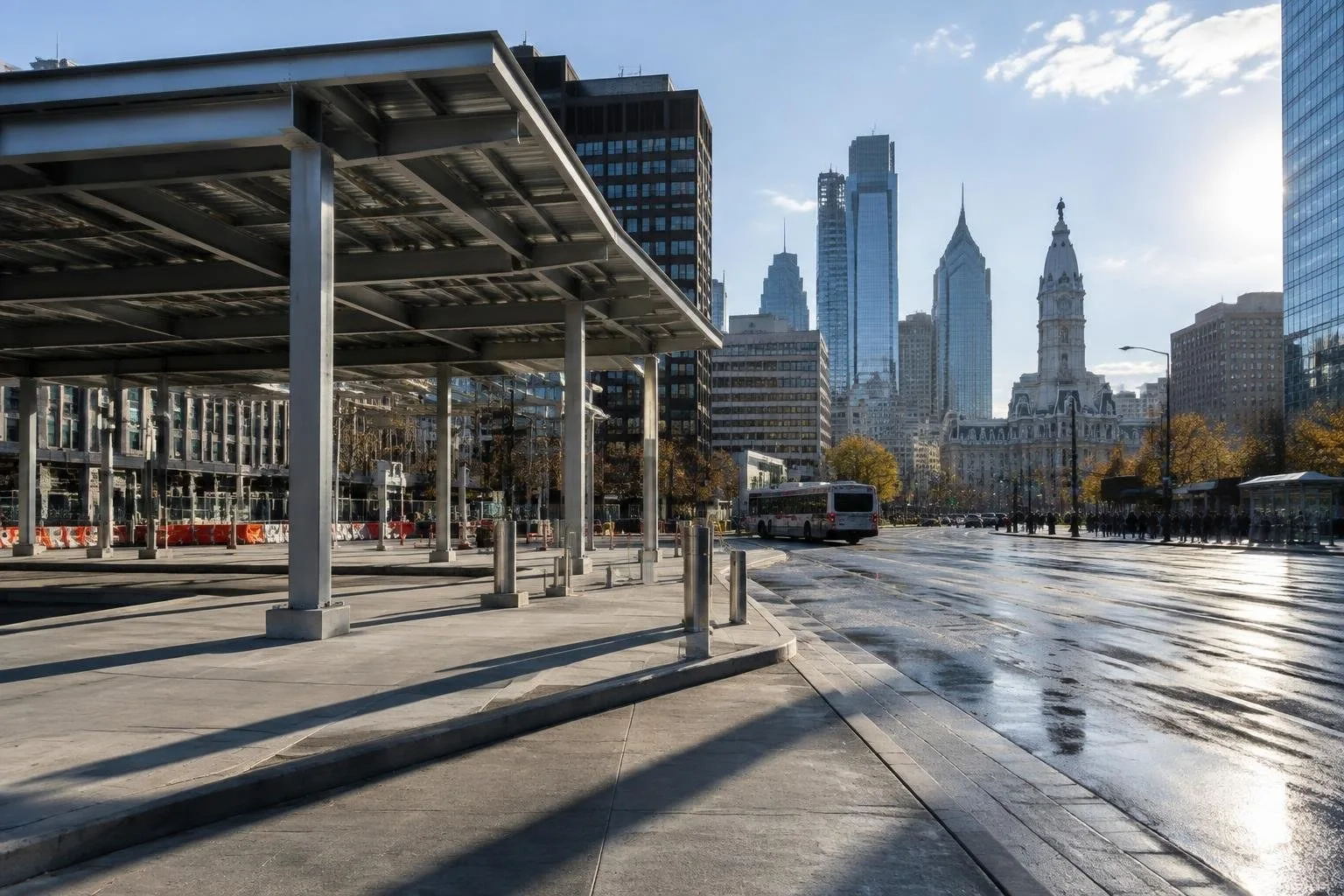
The Philadelphia Office of Planning and Development is closing the first round of public input on a permanent intercity bus terminal. After a February site-screening that trimmed the list to three locations, the agency collected comments from almost 1,800 residents through surveys and in-person meetings, including a public forum on Nov. 4. The department now asks the community to weigh in on updated schematics, sending their thoughts to [email protected].
Three candidate locations under review
30th Street and Arch Street
The parcel at 2931 Arch St. sits on an Amtrak-owned parking lot directly north of 30th Street Station and beside the Cira Centre tower. Respondents repeatedly praised its proximity to regional rail and subway lines. Evan Thalheimer, a Fishtown resident and Drexel architecture student, explained that he often chooses Amtrak for convenience despite higher fares, noting, “it would be great to see a bus station elevated to the same level as something akin to the 30th Street Station.” He described the proposed layout as “the best bus station” because it would give every arriving traveler a uniform experience and eliminate an extra navigation step.
15th Street and Vine Street
This option re-purposes the Philadelphia Gateway garage and an adjoining lot at 1500-1598 Vine St., owned by PennDOT and the Philadelphia Parking Authority. Supporters highlighted the site’s central position, but critics warned of a confusing internal arrangement. Thalheimer illustrated the problem, saying, “the bay is split into two sections with two separate waiting rooms – it would be a wayfinding nightmare.” The feedback board’s post-its listed “most central location” as a pro and “confusing layout” as a con.
8th Street and Arch Street
Closest to the existing 8th-and-Filbert bus depot, this proposal would use two city-owned lots at 701-709 and 721-737 Arch St., adjacent to the African American Museum. The site is leased for a ten-year term that runs until 2036. Nancy Biller, a Bella Vista resident, praised the neighborhood ambience, citing nearby Chinatown, Reading Terminal, and the Liberty Bell. Nonetheless, the location raises coordination challenges with the museum, a federal detention center, and mixed ownership involving Parkway Corp. Routing buses near Chinatown could also provoke local opposition.
Public response and key findings
According to transportation director Mason Austin of the City Planning Commission, the 30th-and-Arch option received the strongest endorsement in Phase 1. Sixty-five percent of respondents voted for this site, while 89 % said they usually arrive at intercity bus stops by walking, biking, or using public transit; only 38 % reported driving or taking a taxi. The survey also revealed that 90 % of bus riders rely on public-transit connections for their trips, underscoring why proximity to rail and subway links topped the priority list, followed by amenities such as waiting areas, restrooms, and real-time arrival information.
Safety and security ranked just behind transit access in the average concern rating. Bruce Bohri, a public-relations specialist with the planning agency, emphasized that the department wants to know how each schematic impacts individual commuters and what factors should shape the final design.
State involvement also entered the discussion. The 15th-and-Vine parcel is state-owned, the 8th-and-Arch site is 60 % city-owned and 40 % privately held, and the 30th-and-Arch location belongs to Amtrak, a government-related corporation. Jawad Pullin, legislative director for state Senator Sharif Street, attended the Nov. 4 meeting, noting that any chosen project will depend on state and federal funding and that the senator’s committee focuses on reliable, well-funded public-transport services.
Where the process goes from here
The planning department plans to publish its final report early next year. After that, the project will move into a technical phase that addresses financing, engineering feasibility, and detailed design. No additional public meeting has been scheduled, meaning the city will rely on the accumulated feedback, both the quantitative survey results and the qualitative comments, to refine the terminal’s configuration.
Stakeholders such as Amtrak, PennDOT, the Philadelphia Parking Authority, and Parkway Corp. will be summoned to participate in the next steps, ensuring that ownership and operational considerations are aligned with the community’s expressed preferences. The ultimate goal, according to Austin, is to create a hub that feels “user-friendly,” reduces barriers to entering or leaving Philadelphia, and supports the city’s broader transit ecosystem.